


Please Leave Us A Message
Privacy statement: Your privacy is very important to Us. Our company promises not to disclose your personal information to any external company with out your explicit permission.
 Jiangsu Changshu Vast Import and Export Trade Co.,LTD
Select Language
English


Apparel display racks are specialized retail fixtures designed to present clothing, garments, and accessories in a way that maximizes visibility, accessibility, and sales potential. Unlike generic shelving units, these systems are engineered specifically for hanging garments on hangers while also incorporating shelves, bins, or hooks for folded items and accessories.
For garment retailers, the right apparel display rack system directly influences how customers interact with your merchandise. A well-designed display encourages browsing, reduces garment handling damage, and creates an organized shopping environment that communicates quality and professionalism. Whether you operate a boutique, department store, or large-format apparel outlet, understanding the fundamentals of display rack design is essential for optimizing your floor plan and increasing conversion rates.
Modern apparel display racks integrate multiple merchandising functions into single units. Steel and wood shelf series configurations allow you to combine hanging spaces with flat surfaces for folded inventory. Wire basket series components provide storage for smaller accessories like scarves, belts, and socks. Promotional cage and table series elements create dedicated zones for seasonal collections and featured products. This modular approach means you can build a complete retail clothing display solution that adapts as your product mix evolves.
Jiangsu Changshu Vast Import and Export Trade Co., LTD operates as an integrated industry-and-trade company specializing in commercial equipment manufacturing. Their facility, Changshu Xinyang Commercial Equipment Co., Ltd., focuses on researching, designing, manufacturing, and producing supermarket shelf accessories and display solutions including apparel display racks, steel and wood shelf series, and wire basket series components.
The company employs advanced welding, bending, and forming equipment alongside sophisticated production technology. This manufacturing capability ensures consistent structural integrity across all display rack products. Each unit undergoes rigorous quality control processes aligned with their core philosophy: "product quality strives for survival, trustworthy practical strives for development."
With more than 100 kinds of products spanning shopping trolleys, supermarket metal hooks, storage racks, living room display racks, logistics carts, warehouse cages, and gardening flower racks, Vast demonstrates deep expertise in metal fabrication and retail fixture engineering. This breadth of experience translates into superior commercial-grade apparel display rack manufacturing built to withstand high-traffic retail environments.
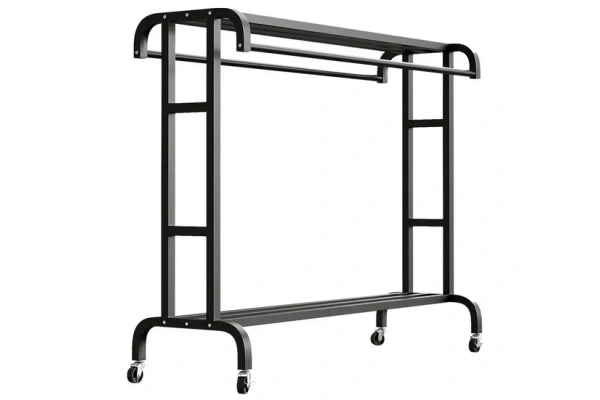
Selecting the optimal apparel display rack for your store requires evaluating several critical factors beyond basic aesthetics. Start by assessing your floor plan dimensions and traffic flow patterns. The most effective display systems maximize product visibility while maintaining clear pathways that encourage customer movement through your selling area.
Steel frames provide structural durability for heavy garment loads, while wood accents add warmth and premium perception to your display aesthetic. Wire basket components offer visibility into accessory storage while maintaining a lightweight, open feel. The best retail clothing rack materials combine these elements strategically — steel for load-bearing structures, wood for shelf surfaces and accent panels, and wire for accessory compartments.
Your display system should accommodate seasonal changes, product mix shifts, and promotional campaigns without requiring complete replacement. Modular configurations with interchangeable components — such as adjustable shelf heights, removable wire baskets, and reconfigurable hanging bars — provide long-term value. Look for suppliers offering compatible accessory series including promotional cages, tables, and vegetable racks that integrate seamlessly with primary display structures.
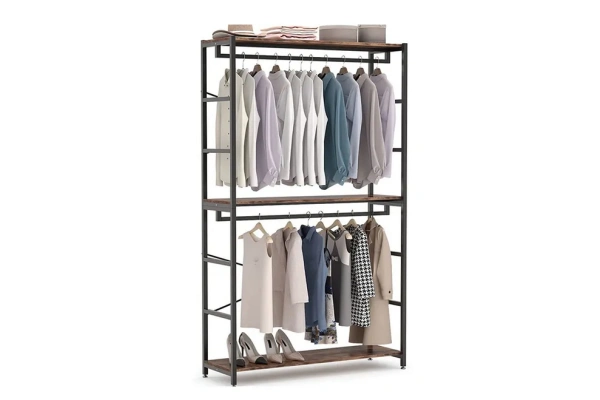
Use this comprehensive checklist when evaluating potential suppliers and display rack configurations. Each item addresses a key decision point that impacts total cost of ownership, operational efficiency, and end-customer shopping experience.
Verify load capacity ratings for hanging bars and shelf surfaces. Ensure frame construction uses adequate gauge steel with reinforced joint connections capable of supporting dense garment loads without deformation over time.
Inspect powder coating consistency, edge smoothing, and corrosion resistance treatments. Superior finishes prevent scratching during garment handling and maintain appearance through years of daily retail use.
Confirm that additional components — wire baskets, promotional cages, shelving attachments — are compatible with the base rack system. Modular ecosystems reduce future procurement costs and simplify expansion.
Evaluate supplier's product range breadth, market reach, and customer feedback history. Companies with extensive product portfolios and global distribution demonstrate manufacturing maturity and reliability.
Assess assembly complexity and required tools. Systems designed for tool-free or minimal-tool installation reduce labor costs and enable rapid store layout changes. Request detailed assembly documentation before purchase.
Look beyond unit pricing. Consider shipping efficiency (flat-pack vs assembled), replacement part availability, warranty terms, and expected service life. Reasonable pricing combined with excellent quality delivers the lowest long-term cost.
When sourcing apparel display racks wholesale, prioritize suppliers who combine manufacturing capability with trade expertise. An integrated industry-and-trade model eliminates intermediary markups while ensuring direct access to production quality controls and customization capabilities.
Suppliers operating both trading and manufacturing operations provide direct factory pricing, faster communication cycles, and greater control over production timelines and quality standards.
A supplier offering 100+ complementary products — from supermarket shelves and wire baskets to logistics carts and promotional displays — enables consolidated procurement and unified design language across your entire retail space.
Suppliers with consistent customer praise across distant markets demonstrate reliable quality, competitive pricing, and responsive after-sales service — three pillars essential for long-term B2B partnerships.
Understanding frequent pitfalls in apparel display rack purchasing helps buyers avoid costly mistakes and make informed decisions from the outset. Below are the most common challenges encountered by retail procurement teams and proven strategies to address them.
Solution: Request detailed technical specifications including maximum hanging weight per bar and shelf load limits before placing orders. Reputable manufacturers using advanced welding and bending equipment consistently meet published load ratings. Always verify these specifications against your actual inventory density requirements.
Solution: Specify powder coating thickness and surface smoothness requirements in your purchase agreement. High-quality finishes eliminate burrs and rough edges that can snag delicate fabrics. Request physical samples or video inspections of finished products before committing to large orders.
Solution: Source all display rack components from a single manufacturer with a unified product ecosystem. Integrated suppliers offering steel and wood shelf series, wire basket series, and promotional accessories ensure full compatibility across all units purchased, simplifying future expansions and repairs.
Solution: Prioritize suppliers offering flat-pack designs optimized for container loading efficiency. Confirm protective packaging standards including corner guards, wrapping materials, and palletization practices. Experienced exporters routinely ship globally with minimal damage rates due to established logistics protocols.
These answers address the most common questions from retail buyers evaluating apparel display rack solutions for their stores. Each response provides actionable guidance to support your procurement decision-making process.
The most durable commercial-grade apparel display racks combine steel frame structures with wood shelf surfaces and wire basket accessories. Steel provides the structural strength needed for heavy garment loads, wood adds premium visual appeal for folded merchandise presentation, and wire components offer lightweight storage for accessories. This combination balances durability, aesthetics, and cost-effectiveness for high-traffic retail environments.
Start by mapping your available floor space and determining optimal aisle widths (typically 36-48 inches for main thoroughfares). Calculate total linear footage of hanging space required based on your SKU count and average garments per SKU. Standard apparel display units typically provide 4-6 feet of hanging space each. Divide your total hanging requirement by individual unit capacity, then factor in additional shelf and accessory space needs. Work with your supplier to create a custom layout plan that maximizes selling square footage while maintaining comfortable customer circulation.
Mixing components works best when sourced from a single manufacturer offering a unified product ecosystem. Companies producing steel and wood shelf series alongside wire basket series, promotional cages, and table series typically engineer all components with standardized connection points and mounting hardware. This compatibility ensures seamless integration between different display types. Verify component compatibility specifications with your supplier before combining products from separate manufacturing lines.
High-quality apparel display racks manufactured with advanced welding and bending technology, proper surface treatments, and adequate steel gauge typically last 8-15 years in active retail environments. Lifespan depends heavily on usage frequency, environmental conditions, maintenance practices, and initial build quality. Regular cleaning, prompt repair of minor damage, and avoiding overload conditions significantly extend service life. Premium manufacturers standing behind their products with strong reputations generally deliver longer-lasting fixtures.
Most modern display rack systems are designed for straightforward assembly with minimal tools. Flat-pack designs ship disassembled to optimize container utilization and reduce freight costs. Assembly typically involves connecting frame sections, attaching shelves and hanging bars, and securing wire baskets or accessories. Many suppliers provide detailed assembly instructions and video guides. For large-scale store fit-outs, some suppliers offer on-site installation services or coordinate with local contractors familiar with retail fixture assembly.
Request detailed information about the supplier's manufacturing capabilities, including equipment types, production processes, and quality control procedures. Evaluate their product portfolio breadth — companies offering 100+ related products demonstrate comprehensive manufacturing expertise. Review customer feedback and market reputation, particularly from buyers in similar retail segments. Ask for product samples or factory video tours to assess build quality firsthand. Suppliers whose philosophy centers on quality-driven survival and trust-based development typically maintain higher standards throughout their operations.
Whatsapp: +44 7761848393
Address: No. 781 Wangzhuang Industrial Park, Yungu Line, Suzhou, Suzhou, Jiangsu China
Website: https://www.vastrolley.com
Privacy statement: Your privacy is very important to Us. Our company promises not to disclose your personal information to any external company with out your explicit permission.
Fill in more information so that we can get in touch with you faster
Privacy statement: Your privacy is very important to Us. Our company promises not to disclose your personal information to any external company with out your explicit permission.